
Introduction to Algorithms for Data Science and Physics
Institute of Modern Physics, Fudan University, Spring/2026
Room H2106B, 8:00–10:40, Wednesdays, Handan Campus
Course Description This course offers an introduction to the fundamental concepts of algorithms and several widely used methods in machine learning, state estimation/inference, and modern data science. A key objective is to help students understand the underlying principles and theoretical foundations of machine learning algorithms. Topics covered include basic probability and statistical techniques, simulation methods, optimization strategies, and essential ideas from high-dimensional problems and reconstruction algorithms. To keep pace with the rapid evolution of big data and modern analytics, the course also explores a selection of contemporary algorithms developed for large-scale data processing and high-dimensional statistical analysis.
Target Audience You are all very welcome to attend the course! This course is intended for advanced undergraduate and graduate students in physics, computer science, data science, or related fields who are interested in the foundations and practical applications of machine learning and modern data analysis. It is also suitable for researchers and professionals seeking to strengthen their understanding of algorithmic methods in state estimate, optimization, computer vision and physics. A basic background in calculus, linear algebra, and probability is recommended, though key concepts will be reviewed as needed throughout the course.
Exercises and Problems Each class will last approximately 45x3=135 minutes. There will be two types of exercises: analytical problems (such as estimates or derivations) and programming assignments. The analytical problems are relatively straightforward, while the programming tasks require more thoughtful design and implementation. Each week, a few programming/theoretical exercises will be assigned to reinforce the key concepts covered in class. These exercises are designed to closely reflect practical techniques in areas such as physics, state estimation, geometric reasoning under uncertainty, and optimization.
Course Grading Policy
- Homework: 30%, except Module F.
- Quiz: 30%, except Module F.
- Final Exam: 40%, except Module F.
Lecture Notes
There will be no designated textbook for the course, lecture notes will be provided progressively as the course develops. Several reference books that offer broad coverage of relevant topics may be helpful for those seeking a deeper understanding and are provided in the syllabus. You do not need to read everything. We are writing a book for this course, contact me if you are interested in it.
- Lecture 1: Order of Magnitude, Estimate and Divide-and-Conquer
- Lecture 2: Taylor’s Expansion, Numerical Calculus and Monte Carlo Integration
- Lecture 3: Statistical Distributions, Bayes Theorem, and Gaussian Random Variable Generation
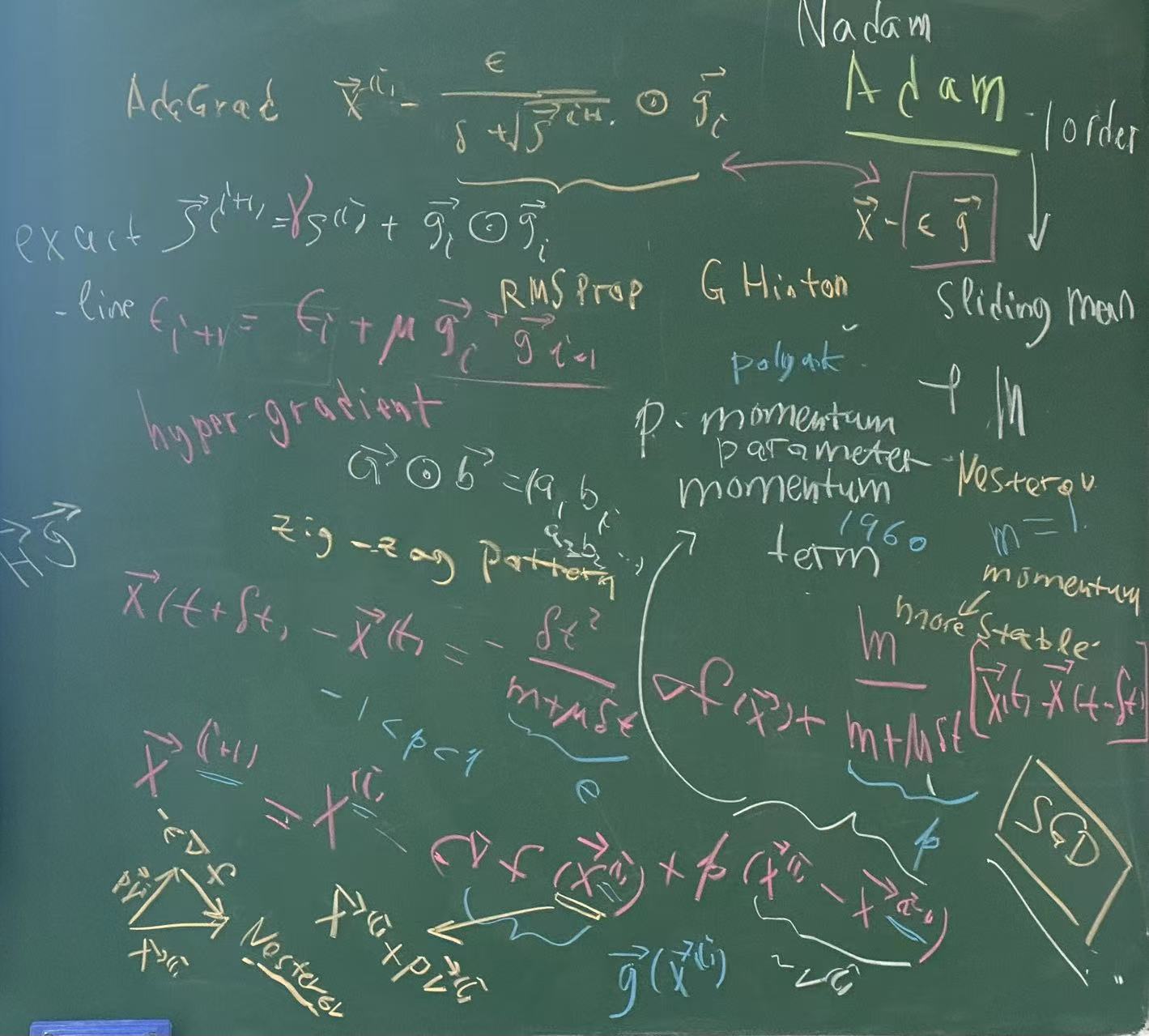
- Lecture 4: Gradient Descent, Regularization, and Mechanism of Momentum
- Lecture 5: First Lesson from “Learning from Data”, Curve Fitting, and “No-free-lunch” Theorem
- Lecture 6: Thermal Motion, Annealing and Advanced Monte Carlo Schemes
Class Material
- Lecture 1: Lecture time 3/4/2026
- Lecture 2: Lecture time 3/11/2026
- Lecture 3: Lecture time 3/18/2026
- Lecture 4: Lecture time 3/25/2026
- Lecture 5: Lecture time 4/1/2026
- Lecture 6: Lecture time 4/8/2026
Homework
- Assignment 1: submit before the lecture of 3/11/2026
- Assignment 2: submit before the lecture of 3/18/2026
- Assignment 3: submit before the lecture of 3/25/2026
- Assignment 4: submit before the lecture of 4/1/2026
- Assignment 5: submit before the lecture of 4/8/2026
- Assignment 6: submit before the lecture of 4/15/2026